
Does your stagger pattern change flooring waste? We laid 250 rooms five ways
27 July 2026
The stagger pattern you pick makes almost no difference to flooring waste, with one expensive exception. We laid the same 250 simulated rooms under five stagger policies with the same 1,285 × 192 mm (about 50.5 x 7.5 in) plank: a fixed ½ board offset averaged 7.3% waste, a fixed ⅓ came to 7.2%, and seeded-random starts 7.1%, a spread most jobs will never notice. The tight ¼ offset cost 0.7 points more and failed to produce a legal layout in 16 rooms. The outlier is the most repeated thrift tip in flooring: starting every row with the previous row's offcut averaged 11.3% waste, 4 full points over the brick bond, and pushed 42% of rooms into buying at least one extra pack.
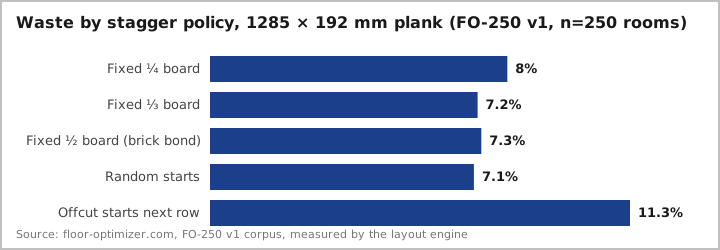
How much waste does each stagger policy produce?
Every figure is Measured by our layout engine on the same rooms with the same board, a 300 mm (about 12 in) minimum joint offset, and offcut reuse planned in every case. The policy is the only thing that changes:
| Stagger policy | Mean waste | Versus fixed ½ | Cuts per m² |
|---|---|---|---|
| Fixed ¼ board | 8.0% | 0.7 points more | 2.4 |
| Fixed ⅓ board | 7.2% | 0.1 points less | 2.4 |
| Fixed ½ board (brick bond) | 7.3% | baseline | 2.2 |
| Random starts | 7.1% | 0.2 points less | 2.5 |
| Offcut starts next row | 11.3% | 4.0 points more | 2.5 |
The first four rows are the finding most people need: pattern or random is an aesthetic decision, not a financial one. The stagger rules guide explains what each policy asks of you on the day; none of the disciplined versions costs meaningful material, and the gap in cutting work is small too, 2.2 to 2.5 cuts per square metre across all five.
Why does the offcut chain cost 4 points?
The method sounds like the definition of thrift: cut the last board of a row, walk the offcut back, start the next row with it. The measured cost comes from what the chain takes away, which is choice:
- The room sets every carry's length. Each offcut is whatever the wall left over, so the next row's stagger is dictated, not chosen. When that start would put a joint within 300 mm of one in the row below, the starter is trimmed until it clears, and the trim goes in the bin.
- A carry that does not fit is forfeited. Offcuts shorter than the 300 mm minimum piece length, or the wrong length for the joint rules, are scrapped and a fresh board is opened, which is exactly what the method promised to avoid.
- Packs feel it. Paired room by room against the brick bond, the offcut chain needed more packs in 42.4% of rooms and fewer in 1.2%. No other policy moved the pack count in more than 11% of rooms in either direction.
- Every room type pays. The penalty ranged from 3.0 points in hallways to 5.0 points in rooms with an island or hearth. It is the constraint that costs, not any particular geometry.
Offcut reuse itself is not the villain. The other four policies reuse offcuts just as hard, but through a cut list that assigns each offcut to wherever in the floor it fits, the difference the reduce waste guide is built around. Chaining each offcut to the very next row is the unplanned version of the same idea, and the 4 points are what the missing plan costs.
Is a random stagger more wasteful than a fixed bond?
Slightly the opposite, and the margin is noise on most jobs. Random starts beat the brick bond by 0.2 points overall and held that shape across room types:
| Room type | Fixed ½ | Random starts | Difference |
|---|---|---|---|
| Plain rectangles | 6.1% | 5.9% | 0.1 points less |
| Hallways and landings | 11.0% | 10.5% | 0.5 points less |
| L-shaped rooms | 7.2% | 6.7% | 0.4 points less |
| Alcoves and bays | 7.0% | 7.6% | 0.6 points more |
| Rooms over 20 m² | 5.3% | 5.2% | 0.1 points less |
So the random look that most plank floors aim for, the one the random ashlar guide describes, is free. The one fixed policy to be wary of is the tight ¼ board offset: it costs 0.7 points, and its 321 mm (about 12.5 in) shift sits so close to the joint rule and the minimum piece length that 16 of 250 rooms produced no legal layout at all, against 3 for random starts. Tight offsets leave the layout no room to dodge awkward geometry. The same conclusions carry over to vinyl plank, where the minimum offsets shrink and a print-repeat rule joins the checklist: staggering vinyl plank flooring covers the differences.
Which policy keeps the joint rules happiest?
None of them fully, and that is worth knowing before blaming your installer. Even with every layout planned and repaired by the engine, some rooms pin a row between an obstacle's cut ends and its neighbours' joints, leaving a warning that no legal shift can clear:
- A third of rooms kept at least one residual joint warning under the fixed policies (30% at ⅓, 32% at ½, 35% at ¼), almost always where a joint aligns with a cut end at an obstacle or doorway.
- Random starts kept a warning in 41% of rooms, and the offcut chain in 50%, the price of having each row's start dictated or drawn rather than chosen.
- The comparison is not symmetrical, by design: H-joint and staircase checks only apply to the random and offcut policies, because a fixed bond's two-row repetition is the chosen pattern rather than an accident. Fixed policies' warnings are all direct joint-offset conflicts.
What counts as an H-joint or a staircase, and what to do when you spot one mid-lay, is covered in fixing joints that line up.
How we measured it
- Corpus: FO-250 v1, our fixed set of 250 simulated rooms (80 rectangles, 30 hallways, 50 L-shapes, 30 alcove or bay rooms, 30 obstacle rooms, 30 multi-room floors), typical residential dimensions, fixed seed.
- Board: 1,285 × 192 mm laminate plank, 9 boards (2.22 m²) per pack, the same reference plank as our other studies, here with the app's craft default 300 mm minimum joint offset switched on, because the joint rule is what stagger policies exist to satisfy. That makes these waste figures slightly stricter than our 10% rule audit, whose boards carried no joint rule.
- Policies: fixed offsets of ¼, ⅓ and ½ board, seeded-random row starts, and offcut-driven starts where each row begins with the previous row's offcut. Stack bond and block patterns are excluded because they have no end-joint stagger to vary.
- Settings: minimum piece length 300 mm, minimum rip width 50 mm, kerf 3 mm, the optimiser's ranked-best plan per room. 1,250 runs, of which 39 were infeasible and excluded; deltas are paired per room so a room that only one policy could lay never skews a comparison.
- Labels: every figure on this page is Measured by the engine. No estimated conversions appear.
- Data: waste by stagger policy and by room type, free to download and cite with attribution. Your room is one room, not an average of 250: the layout planner lays it under any of these policies with the joint rules enforced, and prices the look you prefer in packs before you buy. For a quick rectangle estimate, the laminate calculator is faster.
Frequently asked questions
- Does the stagger pattern change how much flooring I waste?
- Barely, as long as the layout is planned. Across 250 simulated rooms, a fixed ½ board stagger averaged 7.3% waste, a fixed ⅓ came to 7.2% and seeded-random starts 7.1%. Only two choices moved the number: a tight ¼ offset added 0.7 points, and chaining each row to the previous row's offcut added 4.
- Should I start each new row with the offcut from the last row?
- Not as a fixed rule. Rooms laid that way averaged 11.3% waste against 7.3% for a brick bond, and needed at least one extra pack in 42% of rooms. Offcuts still save material, but they save the most when a plan assigns each one to wherever it fits, not automatically to the very next row.
- Is a half board stagger wasteful?
- No. The brick bond's repeating look divides opinion, but its material bill is ordinary: 7.3% mean waste in our data, within 0.2 percentage points of a ⅓ stagger and of random starts. It also needed the fewest cuts of the five policies we measured, at 2.2 per square metre.
- What is the cheapest way to stagger laminate?
- Random starts came out cheapest at 7.1% mean waste, but the margin over a fixed ½ or ⅓ bond is a rounding error on most jobs: 85% to 90% of rooms bought the same number of packs whichever of those three you pick. Choose between them on looks, not on cost.
- Why does the offcut method waste more if it reuses offcuts?
- Because it locks each offcut to one destination. The room's geometry decides every carry's length, so the starter is often trimmed to satisfy the joint rules, and the trim is pure waste. A planned layout reuses the same offcuts but places each one where it fits without trimming.