
Is 10% extra flooring enough? We tested the rule on 2,250 planned floors
23 July 2026
For a planned straight lay in laminate, vinyl plank or wood, 10% extra is enough in roughly 97 of 100 rooms. That is a measured number, not a repeated one: we took the buying rule every guide quotes, applied it to 250 simulated rooms in all nine laying patterns our engine supports, and checked room by room whether "floor area plus 10%, rounded up to whole packs" bought enough boards for the optimised cut list. The rule mostly works, but its two failure modes are worth knowing before you trust it: it fails exactly where rooms are hardest to guess, and for block patterns like chevron it never works at all.
How often does the 10% rule leave you short?
For the two everyday patterns, here is how each flat margin performed across the 250-room corpus. "Short" means the whole-pack purchase held fewer boards than the planned layout used, so the buyer goes back to the shop:
| Margin added | Straight lay, rooms left short | Running bond ½, rooms left short |
|---|---|---|
| 5% | 21.1% | 12.2% |
| 10% | 3.2% | 1.2% |
| 15% | 0.8% | 0% |
| 20% | 0.8% | 0% |
The striking row is the first one. Plenty of sources quote 5% to 7% for a simple room, and even with every cut planned by an optimizer, 5% left 1 room in 5 short on a straight lay. These are best-case floors, with no miscuts and no boards lost to damage. If a margin fails on a perfect plan, it fails harder on a real Saturday. The full room-by-room results are in the downloadable dataset.
Which patterns break the rule completely?
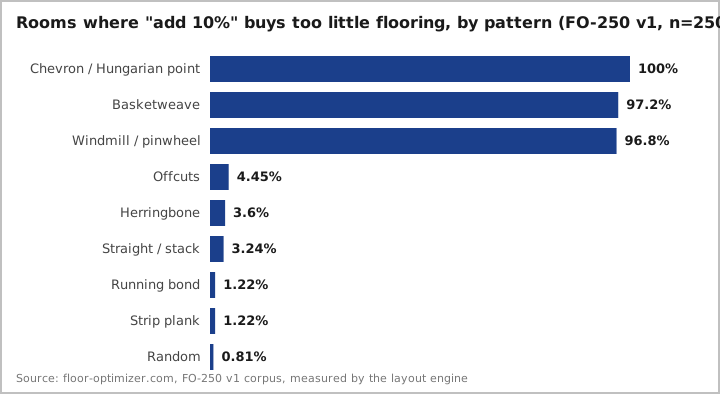
The 10% rule is a linear-pattern rule. Applied to block patterns, it simply fails, and buying to it guarantees a second trip to the shop:
| Pattern | Short at +10% | Short at +20% |
|---|---|---|
| Running bond ½ | 1.2% | 0% |
| Strip plank | 1.2% | 0% |
| Random stagger | 0.8% | 0% |
| Straight lay | 3.2% | 0.8% |
| Herringbone (600 mm blocks) | 3.6% | 0% |
| Offcut-start stagger | 4.5% | 0% |
| Basketweave | 97.2% | 79.2% |
| Windmill | 96.8% | 65.6% |
| Chevron | 100% | 99.2% |
Chevron failed every single room at 10%, and 99% of rooms even at 20%, because its mitred end cuts push waste to around a quarter of the material whatever the room looks like. The one surprise in the other direction is herringbone: laid with parquet-format blocks and a planned cut list, it behaved like a linear pattern, which matches the waste figures in our flooring waste statistics. Herringbone cut from long laminate planks is another matter, and none of this rescues an unplanned herringbone cut by eye.
Where does 10% fail even on an ordinary floor?
The failures are not random. Splitting the straight-lay results by room type, plain rectangles failed at 3.8% while small rooms with an obstacle failed at 10.7%, nearly three times the corpus average. The two rooms in the whole study that beat a 20% margin were both around 7 m² (about 75 sq ft) with a hearth or fitted unit interrupting the rows, wasting 22 to 23% of bought material on a perfectly planned straight lay.
The pattern behind it: waste lives at walls and interruptions, and both grow relative to area as rooms shrink. A chimney breast in a 7 m² room chops almost every row into awkward lengths, exactly the situation covered in the guide to flooring around obstacles. If your room is small and something sticks into it, a flat percentage is guessing; that is the case where running out mid-job actually happens.
What does over-buying cost you?
A flat rule has a second failure mode nobody warns about: in the rooms where it does not run short, it buys packs you will never open. Measured across the non-short straight-lay rooms:
| Margin added | Mean surplus packs | Roughly |
|---|---|---|
| 10% | 0.3 | 0.7 m² |
| 15% | 0.7 | 1.6 m² |
| 20% | 1.2 | 2.7 m² |
Herringbone in small-format blocks was worse still: a 20% margin left an average of 2.6 unopened packs per room. A sensible spare board or two for future repairs is cheap insurance, and boards from the same batch avoid the shade-matching problem later. A pack and a half of insurance you never chose is just money on a shelf.
So how much extra flooring should you buy?
Based on the measured runs, not folklore:
- Planned straight lay or running bond: add 10% and round up to whole packs. Pack rounding is your real safety margin in small rooms.
- Any small room with an obstacle: do not use a flat percentage. Plan the layout first, count the boards, then buy; this is the case the rule cannot see.
- Herringbone in blocks, planned: 10% held in 96% of rooms. Cut by eye, keep the traditional 15% to 20%.
- Chevron, basketweave, windmill: budget from the pattern's real waste (20% to 25% in our pattern comparison), plus your margin for mistakes.
- Any pattern, cut by eye: add your chosen margin on top of these numbers, because everything above assumes a planned cut list.
The percentage-free alternative is to skip the guess entirely: the laminate calculator turns your measurements into a pack count, and the planner lays out your actual room and counts the boards it needs, which is the number every rule above is trying to approximate. For how the percentages themselves are usually estimated, see how much flooring do I need.
How we measured it
- Corpus: FO-250 v1, our fixed set of 250 simulated rooms: 80 rectangles, 30 hallways, 50 L-shapes, 30 rooms with alcoves or a bay, 30 with an obstacle (island, hearth, pillar or fitted unit) and 30 multi-room floors, typical residential dimensions, generated from a fixed seed.
- Runs: every room in all nine engine patterns, 2,250 planned layouts. Boards: 1285 × 192 mm (about 50.5 x 7.5 in) planks (9 per pack, 2.22 m²) for linear patterns, 600 × 120 mm (about 24 x 4.75 in) blocks (14 per pack, 1.01 m²) for block patterns. Minimum piece 300 mm (about 12 in), minimum rip 50 mm (about 2 in), 3 mm kerf.
- The test: a simulated buyer purchases area × (1 + margin), rounded up to whole packs, and is "short" if that holds fewer boards than the optimizer's best layout consumes. Every figure here is Measured from those runs; nothing is estimated.
- Honest caveat: the optimizer plans every cut before the first board. Real-world cutting is less efficient, so treat the short rates as the floor, not the ceiling, of your risk.
- Data: per-pattern outcomes and by room type, free to download and cite with attribution.
Frequently asked questions
- Is 10% extra enough for laminate flooring?
- For a planned straight or offset lay, almost always: in our 2,250-floor simulation the 10% rule left buyers short in only 3.2% of straight-lay rooms, and pack rounding absorbed most of the risk. It failed in small rooms with an obstacle such as a hearth, and in every block pattern.
- How much extra flooring should I buy for herringbone?
- It depends on the format. With parquet-format blocks around 600 mm and a planned cut list, 10% covered 96% of our simulated rooms. Herringbone cut from long planks, or cut by eye without a plan, wastes far more, and the traditional 15% to 20% advice stands there.
- Why did I run out of flooring after adding 10%?
- The usual causes are an obstacle that interrupts rows (a chimney breast, island or fitted unit), a block pattern like chevron or basketweave that no flat percentage covers, or unplanned cutting. Our data shows small obstacle rooms failing the 10% rule three times as often as plain rectangles.
- Does rounding up to whole packs count towards the 10%?
- Pack rounding is a real buffer on top of the percentage, and in small rooms it is often bigger than the percentage itself. In our runs the average straight-lay buyer at 10% carried home 0.3 surplus packs, and at 20% that grew to 1.2 packs of flooring they never opened.