
Herringbone needs 4 times the cuts of a straight floor. We counted every one
24 July 2026
Herringbone needs 4.3 times as many cuts as a straight floor, and chevron needs nearly 12 times. That is the measured result of laying the same 250 simulated rooms in every pattern our engine supports and counting every cut it plans. A plain straight lay averages 1.8 cuts per square metre; the offset row patterns (running bond, strip plank, random stagger) barely move the needle at 2.2 to 2.5; then the diagonals and blocks jump to 7.7 for herringbone, 21 for chevron and over 40 for windmill. The pattern you pick is, more than anything else, a decision about how much of the job is cutting, for laminate, vinyl plank or engineered wood alike.
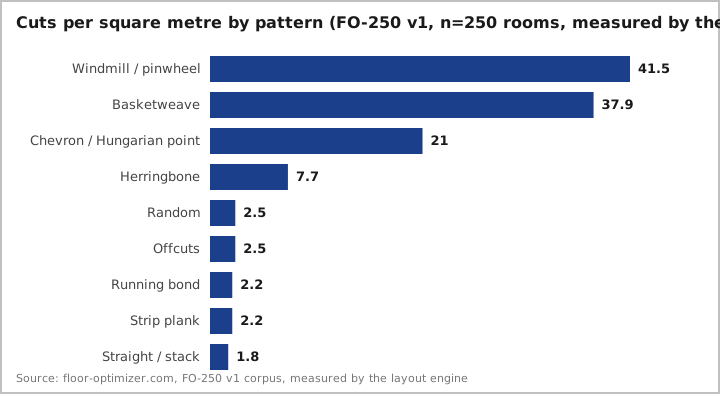
How many cuts does each pattern need?
We counted the cuts the optimiser planned for each layout, then divided by floor area so rooms of different sizes compare. The nine patterns split cleanly into two groups (Measured across 250 rooms):
| Pattern | Cuts per m² | Versus straight lay |
|---|---|---|
| Straight lay | 1.8 | 1× |
| Running bond ½ | 2.2 | 1.2× |
| Strip plank | 2.2 | 1.2× |
| Random stagger | 2.5 | 1.4× |
| Herringbone | 7.7 | 4.3× |
| Chevron | 21.0 | 11.7× |
| Basketweave | 37.9 | 21.1× |
| Windmill | 41.5 | 23.1× |
The five row-based patterns all sit within 1.4 times a straight lay, because they are the same long boards with the join moved along the row: the number of edge pieces hardly changes. The block patterns break every board into small repeating units, so the same floor area needs many more pieces, and every extra piece is two more board ends to cut. This is the cutting side of the story the patterns compared guide tells about waste.
Why do the diagonal patterns cost so much more?
Two different reasons, which is worth knowing before you buy a mitre saw. We also counted how many piece ends carried an angled (mitred) cut rather than a square one:
- Chevron is expensive because of the angles. It averaged 41.8 mitred ends per square metre: every piece is cut on the slant at both ends, and an angled cut is slower to set up and hold than a square one. High cut count and slow cuts together make it the most labour-intensive pattern of the nine.
- Basketweave and windmill are expensive because of the sheer piece count. Their cuts are mostly square (well under one mitred end per square metre), but at 38 and 42 cuts per square metre there are simply a great many of them.
- Herringbone sits in between: 8 mitred ends per square metre, one at each end of most planks, at a cut count (7.7) that is high but nowhere near the geometric patterns. That is why it is the diagonal most people actually attempt. Our herringbone layout guide walks through those angled edge cuts, and chevron vs herringbone weighs the two slanted looks against each other cut by cut.
A guillotine cutter handles a straight lay almost single-handed; the moment you go diagonal, the mitre saw becomes the main tool and the cutting becomes most of the day.
What does that mean in hours?
Cut counts are Measured. To turn them into time we apply one transparent model (Estimated): a set number of minutes to place a piece, make a square cut, add an angled end, or cut a notch. It covers setting-out and cutting only, not underlay, subfloor prep or breaks, so treat the ratios as the message rather than the clock readings. For a 20 m² (about 215 sq ft) room:
| Pattern | Est. cutting and fitting time | Versus straight lay |
|---|---|---|
| Straight lay | 1.5 hours | 1× |
| Running bond ½ | 1.6 hours | 1.1× |
| Random stagger | 1.7 hours | 1.2× |
| Herringbone | 7.4 hours | 5× |
| Basketweave | 17.7 hours | 11.8× |
| Chevron | 19.6 hours | 13× |
| Windmill | 19.4 hours | 12.9× |
The jump from "an afternoon" to "the better part of two days" between a straight lay and a chevron is the number worth carrying into the pattern decision. It also feeds the whole-job estimate in how long it takes to lay laminate: the pattern multiplier lands almost entirely on the cutting, which is the part a first-timer is slowest at anyway.
Does the room shape change the cutting work?
It does, and hallways are the surprise. A long, narrow room has more edge per square metre than a square one, and in a diagonal pattern every edge is a mitred cut, so the per-metre cutting rises sharply (herringbone, Measured):
| Room type | Herringbone cuts per m² |
|---|---|
| Hallways and landings | 13.4 |
| Rooms with an obstacle | 7.6 |
| L-shaped rooms | 7.1 |
| Alcoves and bay windows | 6.8 |
| Rectangles | 6.6 |
| Multi-room floors | 6.5 |
A herringbone hallway needs roughly double the cuts per square metre of a herringbone in an open rectangle. If you want a diagonal in a corridor, that is where the hours go, and where planning the cut list in advance saves the most.
How we measured it
- Corpus: FO-250 v1, our fixed set of 250 simulated rooms (80 rectangles, 30 hallways, 50 L-shapes, 30 alcove or bay rooms, 30 obstacle rooms, 30 multi-room floors), typical residential dimensions, fixed seed.
- Patterns: all nine the engine supports, at default settings. Linear patterns were laid with a 1285 × 192 mm (about 50.5 x 7.5 in) plank, the block patterns with a 600 × 120 mm (about 24 x 4.75 in) parquet-format board, the same reference boards as our 10% rule audit so the two datasets line up.
- Counts: the engine's own cut count per layout, plus the mitred ends and notch cuts read off each planned piece. Every count is Measured; 19 of the 2,250 runs were infeasible and excluded.
- Time: an Estimated per-operation model (place, square cut, angled end, notch) applied to the Measured counts. It is a relative index of cutting and setting-out effort, not a full installation clock.
- Data: cuts by pattern and by room type, free to download and cite with attribution. The planner does this counting for your actual room: draw it in the app and the cut list comes with it, alongside the pack count a laminate calculator gives you.
Frequently asked questions
- Does herringbone take longer to lay than straight flooring?
- Yes, considerably. Across 250 simulated rooms, herringbone needed 4.3 times as many cuts per square metre as a straight lay, and nearly every piece carried two angled ends. On our time model that turned a 1.5 hour cutting-and-fitting job on a 20 m² room into roughly 7 hours.
- How many cuts does laying laminate take?
- For a straight lay, about 1.8 cuts per square metre in our data, so a 20 m² room is around 35 cuts. Running bond and random staggers add a little (2.2 to 2.5 per square metre). Diagonal and block patterns are in a different league: chevron averaged 21 cuts per square metre.
- Which flooring pattern is fastest to lay?
- A straight lay, then the offset row patterns (running bond, strip plank, random stagger), which all sat within 1.4 times the straight-lay cut count. If speed is the priority, keep the boards running in rows and save the diagonals for a floor you have time for.
- Why does chevron take so long to lay?
- Every chevron piece is cut with a mitre at both ends, so the cut count (21 per square metre) is high and each cut is slower than a square one. Chevron carried nearly 42 mitred ends per square metre, which is why our time model ranks it the slowest pattern of the nine.