
Do wide planks waste more flooring? We laid 6,750 floors to find out
26 July 2026
Wide planks do waste more, and now there is a number on it: laid across the same 250 rooms in a straight pattern, a 305 mm (about 12 in) extra-wide plank averaged 10.2% waste against 5.7% for a 94 mm (about 3.7 in) strip. That is close to twice as much material lost, or about 1 m² (about 11 sq ft) of extra flooring on a 20 m² (about 215 sq ft) room, which is half a pack. The often-repeated "add 3% for wide boards" turns out to be roughly right for the very widest formats and roughly double the real cost for the 244 mm (about 9.6 in) boards most shops actually sell as wide plank. The more useful finding is that the penalty is not a flat adder at all. It lands almost entirely in small rooms and hallways, and in a large open room a wide plank costs close to nothing.
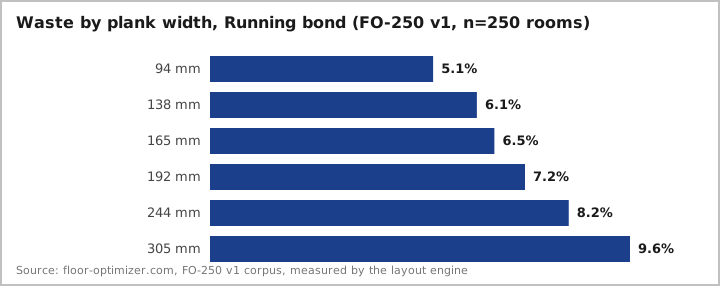
How much does waste rise with plank width?
Waste climbs steadily with width, in the same direction for both row patterns we tested. Every figure below is Measured by our layout engine on the FO-250 v1 corpus, at a fixed 1285 mm (about 50.5 in) plank length so width is the only thing changing:
| Plank width | Straight lay | Running bond ½ | Versus 192 mm |
|---|---|---|---|
| 94 mm strip | 5.7% | 5.1% | 2.3 points less |
| 138 mm | 6.8% | 6.1% | 1.2 points less |
| 165 mm | 7.1% | 6.5% | 0.9 points less |
| 192 mm standard | 8.0% | 7.2% | baseline |
| 244 mm wide | 8.9% | 8.2% | 0.9 points more |
| 305 mm extra wide | 10.2% | 9.6% | 2.2 points more |
It happens at the last row. Room width divided by plank width leaves a remainder that has to be ripped down the length of the room, and the wider the plank, the wider that leftover strip can be. A 94 mm strip can never leave more than 93 mm to lose. A 305 mm plank can leave 304 mm. That finer granularity is also what makes narrow boards easier to split into two healthy edge rows, which the first and last row guide covers.
Is the "add 3% for wide planks" rule right?
It holds up only if "wide" means the widest thing on the market. The claim gets repeated without evidence in several buying guides, and our data splits it into three cases:
- 192 mm to 244 mm (about 7.5 to 9.6 in), the step most buyers actually make: 0.9 points. A flat 3% margin over-buys here, roughly a fifth of a pack on a 20 m² room.
- 192 mm to 305 mm, the premium extra-wide look: 2.2 points. Close enough to 3% that the folklore is defensible.
- Narrow boards get no credit at all in the published advice, yet a 94 mm strip saved 2.3 points against the standard plank. If you add a flat percentage for wide boards, consistency says you should subtract one for narrow strips, and nobody does.
So the rule is the wrong shape more than it is the wrong size. No single number can describe an effect that varies by a factor of two depending on the room. Our 10% rule audit ran into the same problem with flat waste margins generally.
Which rooms actually pay for wide planks?
Small rooms and corridors carry nearly all of it. Comparing a 305 mm plank against the 192 mm reference in the same room, on a straight lay:
| Room | Waste at 192 mm | Waste at 305 mm | Penalty |
|---|---|---|---|
| Under 10 m² | 11.6% | 15.2% | 3.6 points |
| 10 to 20 m² | 7.7% | 9.6% | 1.9 points |
| Over 20 m² | 6.0% | 7.7% | 1.7 points |
| Hallways and landings | 12.0% | 15.7% | 3.8 points |
| Plain rectangles | 7.2% | 9.4% | 2.1 points |
A hallway is the worst case twice over: it starts from a high waste figure because nearly every board touches both walls, then the wide plank adds almost 4 points on top. In a room over 20 m² the same upgrade costs 1.7 points, which on most jobs disappears inside the rounding to whole packs. The practical version of the rule is therefore wide planks waste more in small rooms. In a small room a very wide board tends to look out of scale too, a point the plank sizes guide makes on aesthetic grounds. If you are weighing the whole decision rather than just the waste, the wide vs narrow plank guide folds these numbers into the look, room and price trade-offs.
What do you get back for the extra material?
Time, and a lot of it. A floor with fewer rows has fewer row ends to cut:
| Plank width | Cuts per m² (straight lay) | Versus 94 mm |
|---|---|---|
| 94 mm | 3.36 | 1× |
| 138 mm | 2.42 | 0.7× |
| 192 mm | 1.84 | 0.55× |
| 244 mm | 1.50 | 0.45× |
| 305 mm | 1.26 | 0.37× |
Going from a 94 mm strip to a 305 mm plank cuts the cutting work by about 62%. Neither width is simply better: narrow boards buy material efficiency with labour, and wide boards buy labour efficiency with material. Our cuts by pattern dataset puts a time model on cut counts if you want to price that swap in hours rather than in cuts.
Do longer planks waste more as well?
They do, and almost nothing published says so. Holding width at 192 mm and sweeping length on a straight lay:
| Plank length | Mean waste | Versus 1285 mm |
|---|---|---|
| 900 mm | 8.1% | 0.1 points more |
| 1285 mm | 8.0% | baseline |
| 1500 mm | 8.7% | 0.7 points more |
| 2000 mm | 10.0% | 2.0 points more |
The 2000 mm (about 79 in) plank sold as a premium long-board look costs about as much waste as the 305 mm extra-wide one. Blame the offcut at the end of each row. Long boards leave long remainders, and a remainder too long to throw away without wincing but too short to start the next row is exactly the piece that ends up as waste. Whether your room length lands on a good multiple or a bad one swings this more than the board does, which is the argument the reduce waste guide makes for putting offcut reuse ahead of buying margin.
Are wide planks more likely to leave a sliver last row?
They are less likely to, and the reason matters more than the result. Pinning a full board against the wall and letting the far row fall where it falls, the share of rooms whose last row comes out under 50 mm (about 2 in, the width below which a strip is not worth laying) drops as boards get wider: 47.8% of rooms with a 94 mm strip, 26.5% at 192 mm, 13.2% at 305 mm.
That is arithmetic rather than a virtue. The 50 mm limit is fixed, so it covers over half of a 94 mm row step and only a sixth of a 305 mm one. A wide plank's bad last row is not a sliver at all, it is a broad and expensive rip, and the waste table further up already counted it. Both figures also come with a condition attached: these strip widths are calculated from the room geometry for an unplanned start, not taken from the planned layouts the waste figures come from. A planned floor avoids slivers at either width by splitting the remainder across the first and last rows, which is exactly what the planner does, and why last row too thin is a solvable problem rather than a property of your boards.
How we measured it
- Corpus: FO-250 v1, our fixed set of 250 simulated rooms (80 rectangles, 30 hallways, 50 L-shapes, 30 alcove or bay rooms, 30 obstacle rooms, 30 multi-room floors), typical residential dimensions, fixed seed.
- Boards: six widths from 94 to 305 mm at a fixed 1285 mm length, and four lengths from 900 to 2000 mm at a fixed 192 mm width. 1285 × 192 mm is the reference every delta is measured against. Planks per pack were set per format so pack coverage stays near 2.2 m², because packs are sold by area and comparing pack counts across formats would otherwise measure the pack.
- Patterns: straight lay, running bond ½ and herringbone, one simple, one offset and one diagonal. Herringbone here is laid with the same plank rather than a parquet block, so its waste (12.9% to 17.7%) is comparable only across the widths in this study, not against our other datasets.
- Settings: minimum piece length 300 mm, minimum rip width 50 mm, kerf 3 mm, the optimiser's ranked-best plan per room. 6,750 runs in total, of which 119 were infeasible and excluded.
- Labels: every waste and cut figure is Measured by the engine. The unplanned last-row widths are exact geometry calculated from each room polygon, and are labelled as such above because they describe a different layout from the waste numbers.
- Data: waste by plank format and by room type, free to download and cite with attribution. To settle it for your own room rather than the average one, draw it in the layout planner and swap the board dimensions: the waste, pack count and last-row width update per format, which is a better answer than any percentage rule. The laminate calculator covers plain rectangles.
Frequently asked questions
- Do wide planks waste more flooring?
- Yes. Across 250 simulated rooms laid in a straight pattern, a 305 mm extra-wide plank averaged 10.2% waste against 5.7% for a 94 mm strip, so close to twice as much material. The step up from a standard 192 mm plank to 305 mm costs 2.2 percentage points.
- Is the "add 3% for wide planks" rule correct?
- Only at the extreme. Going from a 192 mm standard plank to a 305 mm extra-wide one cost 2.2 points in our data, near the claimed 3%. But the 244 mm boards most shops sell as wide plank cost only 0.9 points, so a flat 3% over-buys for the format most people actually choose.
- Which rooms suffer most from wide planks?
- Small ones and corridors. Under 10 m² the jump from 192 mm to 305 mm cost 3.6 percentage points, and in hallways 3.8 points, against 1.7 points in rooms over 20 m². Wide planks are close to free in a large open room and expensive in a 6 m² hall.
- Do wide planks need fewer cuts?
- Considerably fewer. Cuts per square metre fell from 3.4 with a 94 mm strip to 1.3 with a 305 mm plank, a drop of about 62%, because there are far fewer rows to cut ends for. Wide planks trade material for time, and narrow ones trade time for material.
- Do longer planks waste more than shorter ones?
- On row-based patterns, yes. A 2000 mm plank averaged 10.0% waste against 8.0% for a 1285 mm plank of the same width, because the offcut left at the end of each row is longer and more often too long to be worth keeping and too short to start a row.